

What Is Sacred Intimacy? A Gentle Guide for Men Who Want to Feel More Connected
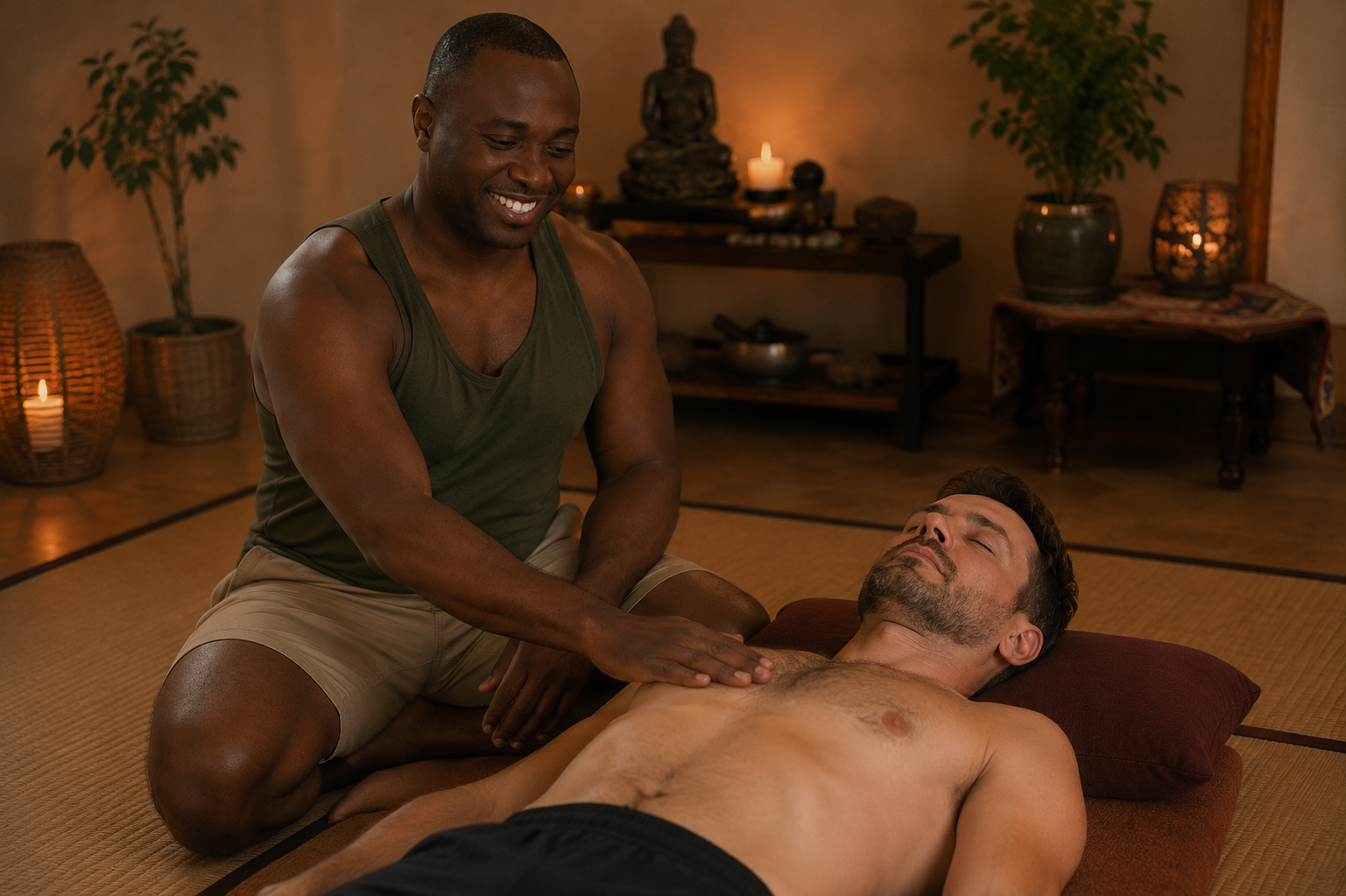
There are some phrases that sound beautiful until you realize you’re not entirely sure what they mean.
“Sacred intimacy” can be one of them.
It might sound soulful and intriguing. It might sound a little mysterious. It might sound like something whispered by a man in linen pants somewhere near Topanga while holding a cup of ceremonial cacao. And honestly, I understand the hesitation.
But in my work, sacred intimacy is not about being mystical, performative, or spiritually impressive. Thank God. Most of us are already tired enough.
Sacred intimacy is about bringing more care, presence, consent, and honesty to the parts of ourselves we often hide: our need for touch, our longing for connection, our relationship with desire, our body shame, our fear of being seen, and the places where intimacy feels both wanted and slightly terrifying.
In simpler terms: it is intimacy treated with respect.
Sacred Does Not Mean Serious
When I say “sacred,” I do not mean heavy, precious, or humorless. I do not believe healing requires everyone to speak in hushed tones while pretending they have transcended awkwardness. Awkwardness is part of being human. Sometimes intimacy is tender. Sometimes it is beautiful. Sometimes you are trying to breathe into your body while also wondering whether your stomach just made a noise loud enough to have its own Instagram account.
Sacred, to me, means we slow down enough to pay attention.
We treat the body as something worthy of care. We treat desire as something worth listening to, not something to shame, rush, hide, or perform. We treat boundaries as part of intimacy, not interruptions to it. We treat touch as communication, not just sensation.
Many men have never had much space for this. We are often taught to be strong, capable, sexually confident, emotionally contained, and preferably not in need of too much tenderness. The result is that a lot of men know how to function, flirt, perform, please, protect, or disappear, but not necessarily how to receive.
Sacred intimacy offers another way in.
Why Men Are Drawn to Sacred Intimacy
Men come to this work for many different reasons.
Some feel disconnected from their bodies. Some are touch-starved. Some are carrying sexual shame from religion, family, culture, past relationships, or years of trying to fit themselves into a version of masculinity that never quite felt like home.
Some men are sexually experienced but not deeply connected to their own desire. Some are confident in public but guarded in private. Some are longing for affection, but every time real closeness shows up, their nervous system acts like someone pulled a fire alarm.
This does not mean something is wrong with them. Often, it means their body learned to protect them.
I have seen this again and again in my work with men. A man may crave intimacy and still brace against it. He may want to be seen and still hide. He may want touch and still tense when care is offered. He may want pleasure but feel shame the moment he admits it matters.
Sacred intimacy gives us a way to explore those patterns gently, with the body included in the conversation.
How Sacred Intimacy Fits Into My Larger Work
At Trevor James, my work is rooted in helping men feel more connected to themselves and others through touch, embodiment, intimacy coaching, sacred intimacy, massage, cuddle therapy, workshops, and retreats.
Each of these offerings meets a different need.
Massage may help you relax, release physical tension, and reconnect with your body. Cuddle therapy may support your need for safe, platonic affection and comfort. Intimacy coaching may help you understand and shift patterns in communication, desire, receiving, emotional availability, and relationships.
Sacred intimacy sits in a particular place within that larger ecosystem. It is for the man who wants to explore the deeper relationship between touch, desire, shame, pleasure, boundaries, and self-trust.
It is not always the first doorway. Sometimes massage is the right beginning. Sometimes coaching is. Sometimes a man simply needs to experience safe touch before he is ready to talk about desire, and sometimes he needs language before his body can relax enough to receive.
The work is not about forcing a dramatic breakthrough. It is about finding the right pace and the right doorway.
What Sacred Intimacy Is Not
Because this work is often misunderstood, I want to be very clear.
Sacred intimacy is not sex work. It is not a hookup. It is not an escort service. It is not a vague “anything can happen” situation with nice lighting.
It is also not therapy, though it can be deeply supportive. I do not diagnose or provide clinical mental health treatment. My work is coaching-based, body-aware, trauma-informed, consent-forward, and grounded in helping you build more self-awareness, capacity, and choice.
There may be sensuality in sacred intimacy, but sensuality does not automatically mean sex. Sensuality is about the senses: breath, warmth, touch, rhythm, pressure, presence, pacing, and awareness. A hot shower is sensual. A beautiful meal is sensual. Clean sheets after a long day are basically a religious experience. None of that has to be sexual to be meaningful.
Sacred intimacy creates room to explore the body and desire without collapsing everything into performance or release.
What You Might Explore
Depending on what you need, sacred intimacy may include conversation, grounding, breath, mindful touch, consent practices, boundary work, sensual awareness, guided receiving, or reflection on shame, pleasure, and desire.
We might explore what happens in your body when you are offered care. We might notice where you tense, where you soften, where you disconnect, or where your mind tries to take over the entire experience like an overqualified intern.
We might look at why receiving feels hard. Why desire feels complicated. Why asking for what you want brings up embarrassment. Why pleasure feels safer when it is rushed, hidden, or performed instead of actually felt.
This is not about fixing you. It is about helping you become more honest with yourself.
Who This Work May Be For
Sacred intimacy may be helpful if you feel disconnected from your body, unsure how to receive touch, curious about erotic energy, burdened by sexual shame, or ready to explore intimacy in a more embodied way.
It may also be helpful if you are gay, bi, straight, queer, curious, questioning, or simply a man trying to understand himself with a little more kindness. Your label is not the main point. Your relationship with yourself is.
Many of the men I work with are thoughtful and self-aware. They have done some inner work. They may have read the books, had the therapy, listened to the podcasts, and developed a very impressive vocabulary for their patterns. And still, when intimacy gets real, the body does something else.
That is where body-based work can be so useful.
A Gentler Way Back to Yourself
For me, sacred intimacy is ultimately about helping men feel more at home in themselves.
Not more impressive. Not more “healed.” Not more spiritually polished. More honest. More present. More able to feel. More able to name what they want and what they do not want. More able to receive care without immediately turning it into a performance review.
In a world that often teaches men to hide their tenderness, outsource their touch needs to sex, and treat desire like either a conquest or a problem, sacred intimacy offers another path.
A quieter one.
A more respectful one.
A more human one.
Your need for connection is not embarrassing. Your longing for touch is not a flaw. Your desire to feel more alive in your body is not too much.
Sometimes the work begins with one simple admission:
“I want to feel more connected.”
That is enough.
And honestly, it is a very good place to begin.